For years, businesses have been told the same thing:
Get more reviews and your local SEO will improve.
That advice isn’t wrong—but it’s incomplete.
In 2026, reviews no longer influence visibility simply because they exist. They influence visibility because of how consistently, quickly, and credibly a business behaves around them.
At ResponseRx, we’ve seen this pattern repeatedly across real review histories. The businesses that win local search aren’t the ones with the cleverest marketing—they’re the ones exhibiting the strongest operational signals in public.
Reviews start the conversation.
Response behavior proves the operation behind it.
Google’s local algorithm has always tried to answer one question:
Is this a real, trustworthy, actively managed business that people choose—and would choose again?
Historically, Google inferred the answer from proximity, relevance, links, citations, and review volume.
Those signals still matter. But today, Google has access to something far more revealing:
Behavior over time.
Reviews provide raw input.
Responses reveal patterns.
Patterns are hard to fake—and extremely valuable to search engines.
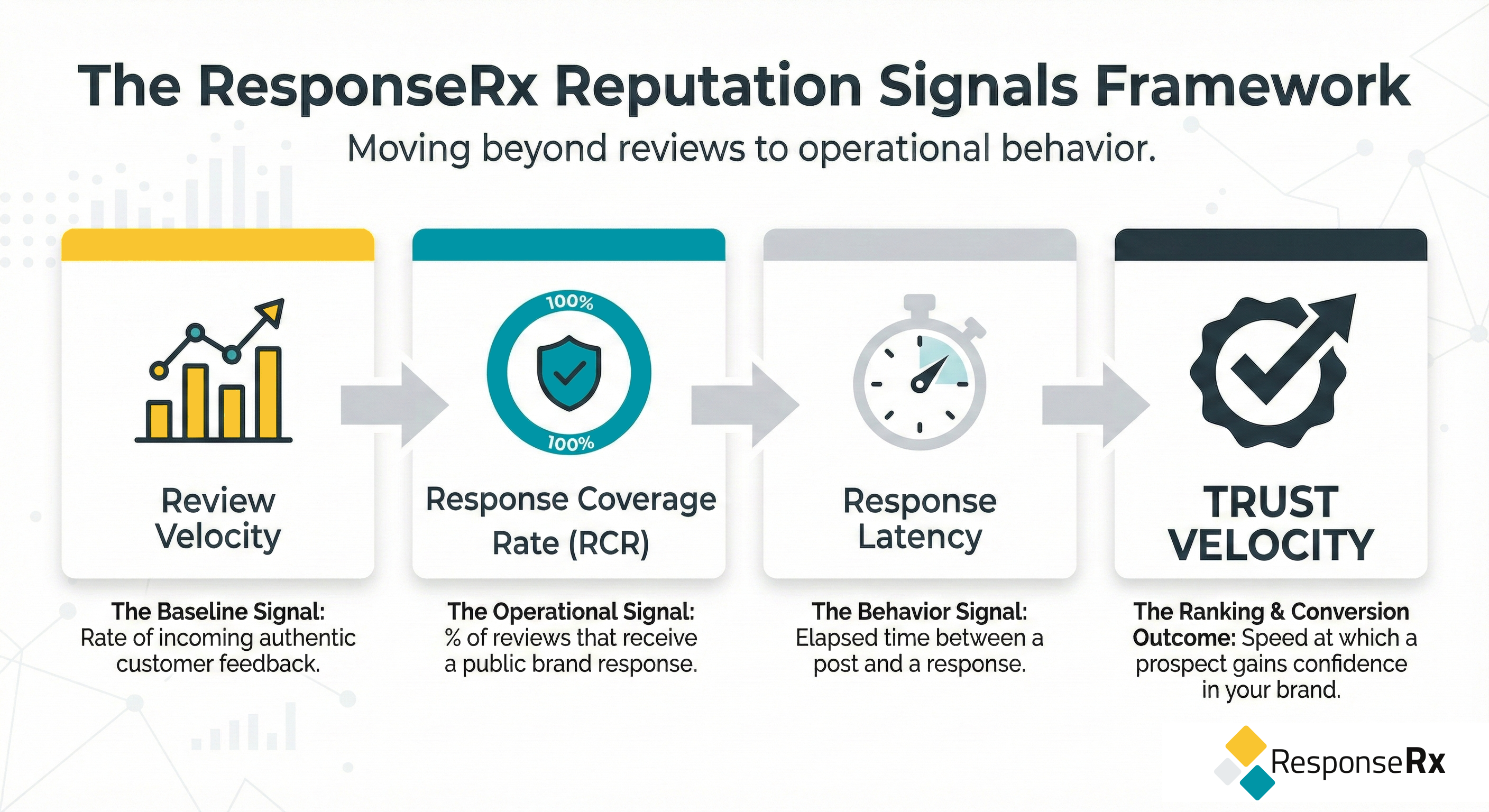
To make this shift concrete, we use a small set of terms internally at ResponseRx. They help explain what’s actually happening behind rankings—and why some businesses quietly outperform others with similar ratings.
Review Velocity is the rate at which a business earns new, authentic reviews over time.
This concept is widely discussed—and for good reason. A steady cadence of new reviews signals relevance and ongoing customer activity.
But velocity alone is no longer the differentiator.
Response Coverage Rate (RCR) is the percentage of reviews that receive a public response.
A business that responds to 100% of reviews sends a fundamentally different signal than one that responds selectively—even if their star ratings are identical.
To customers and search engines alike, completeness matters.
Response Latency measures the time between when a review is posted and when a response appears.
Fast responses communicate attentiveness and accountability.
Slow or inconsistent responses quietly suggest the opposite.
Latency is behavior.
Behavior compounds.
Trust Velocity is the speed at which a prospective customer can move from skepticism to confidence by scanning a business’s reviews and responses.
This is where SEO and conversion intersect.
A profile with high Trust Velocity doesn’t just rank—it converts.
Most conversations about local SEO stop at freshness and engagement.
What they miss is what response behavior reveals over time:
These are operational truths—not marketing claims.
And they’re visible.
Here’s the part most businesses misunderstand:
Your response is not primarily for the reviewer.
It’s for everyone who reads it next.
Every response becomes part of a public operating record:
That record shapes Trust Velocity long before someone clicks “Call.”
This isn’t a motivation problem.
It’s a systems problem.
We see the same patterns repeatedly:
Manual response programs don’t fail because teams don’t care.
They fail because humans are inconsistent under operational load.
Google doesn’t grade effort. It observes outcomes.
From Google’s perspective, response behavior is valuable because it is:
A business that consistently responds—promptly and calmly—signals stability.
Stability compounds.
Automation isn’t about replacing humans.
It’s about stabilizing behavior when humans can’t maintain consistency at scale.
At ResponseRx, BrandVoice AI exists to protect:
In other words, it preserves behavioral signals, not just workflows.
Local SEO in 2026 rewards businesses that demonstrate:
Reviews surface the signal.Responses clarify it.
Instead of asking, “Did we respond to reviews?” ask:
These are observable behaviors—not opinions.
Local SEO is no longer being won by the businesses with the best content.
It’s being won by the businesses with the most consistent public behavior.
Reviews initiate trust.Response behavior compounds it.