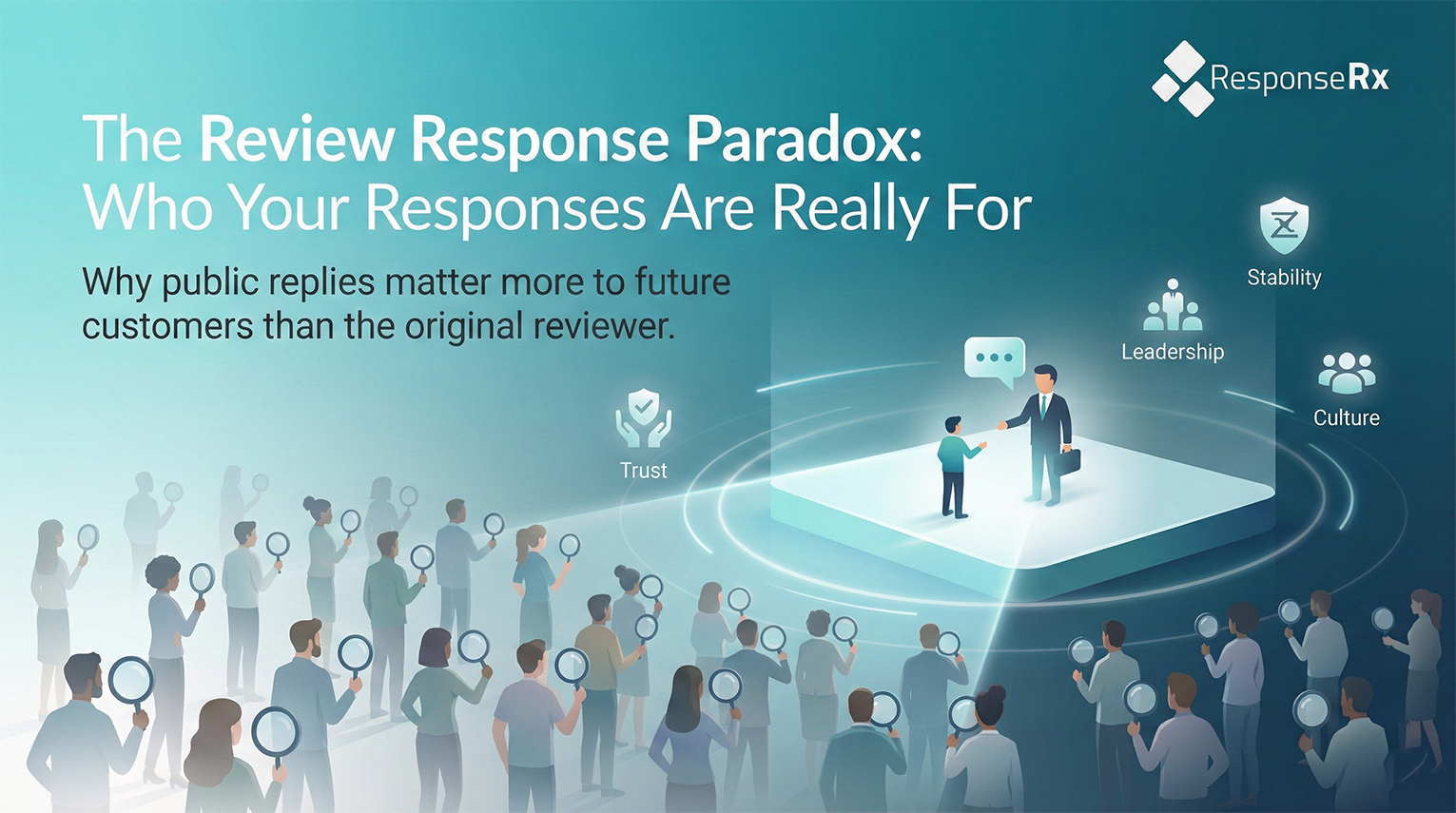
Most review responses are written as if they’re private messages. They aren’t. They’re public artifacts — read by far more people than the original reviewer.
That’s the Review Response Paradox:
Your response matters more to people who never wrote the review.
The reviewer has already formed their opinion. Your future customers are still deciding.
When someone scans reviews, they aren’t just reading feedback. They’re evaluating how the business behaves under scrutiny.
Every reply becomes part of a public operating record:
Those signals shape perception more than the original review itself.
A glowing review with no response signals passivity.
A negative review with a defensive response signals fragility.
A calm, accountable response signals stability.
The original reviewer isn’t the audience anymore. The silent majority is.
For every person who leaves a review, dozens — sometimes hundreds — read it later.
Those readers are asking:
Your response answers those questions instantly. Not because of what you promise — but because of how you behave.
Many businesses overthink review responses because they assume they must “win” the exchange. But review responses are not debates. They are demonstrations.
Review responses demonstrate:
Future patients and customers aren’t judging who was right. They’re judging whether the business feels safe. A brief, steady, accountable reply is often more powerful than a long defensive explanation.
Silence is. Most organizations rush to respond to negative reviews and ignore positive ones.
That selective engagement creates a visible pattern:
To a future reader, that suggests reactive leadership, not consistent leadership. The strongest reputations are built on predictable presence — not selective urgency.
Inside the ResponseRx Reputation Signals Framework, responses are not customer service gestures. They are trust signals. And trust signals compound.
When responses are:
They accelerate Trust Velocity — the speed at which someone moves from uncertainty to confidence. The faster that confidence forms, the faster decisions happen.
The problem isn’t that teams don’t care. It’s that review responses are often:
That inconsistency becomes visible over time. Future readers don’t know the context. They only see the pattern.
To resolve the Review Response Paradox, shift your mental model.
Instead of asking:
“How do I respond to this person?”
Ask:
“What does this response teach future readers about how we operate?”
That subtle shift changes everything.
Strong response patterns typically share five traits:
The goal isn’t to satisfy the reviewer. It’s to make future readers feel secure.
Review responses are not private exchanges. They are public signals.
Signals of leadership.
Signals of stability.
Signals of culture.
The reviewer already formed their opinion. Your future customers are still deciding. And in that moment of evaluation, your response may matter more than the review itself.
Reputation isn’t built by what people say about you. It’s built by how you respond when they do.