Most businesses believe they have a review response strategy. In practice, what they usually have is a response habit — and habits break under pressure.
A review gets answered when someone notices it, has time, and feels confident responding. When those conditions aren’t met, the review sits unanswered. That inconsistency is exactly what Response Coverage Rate (RCR) exposes.
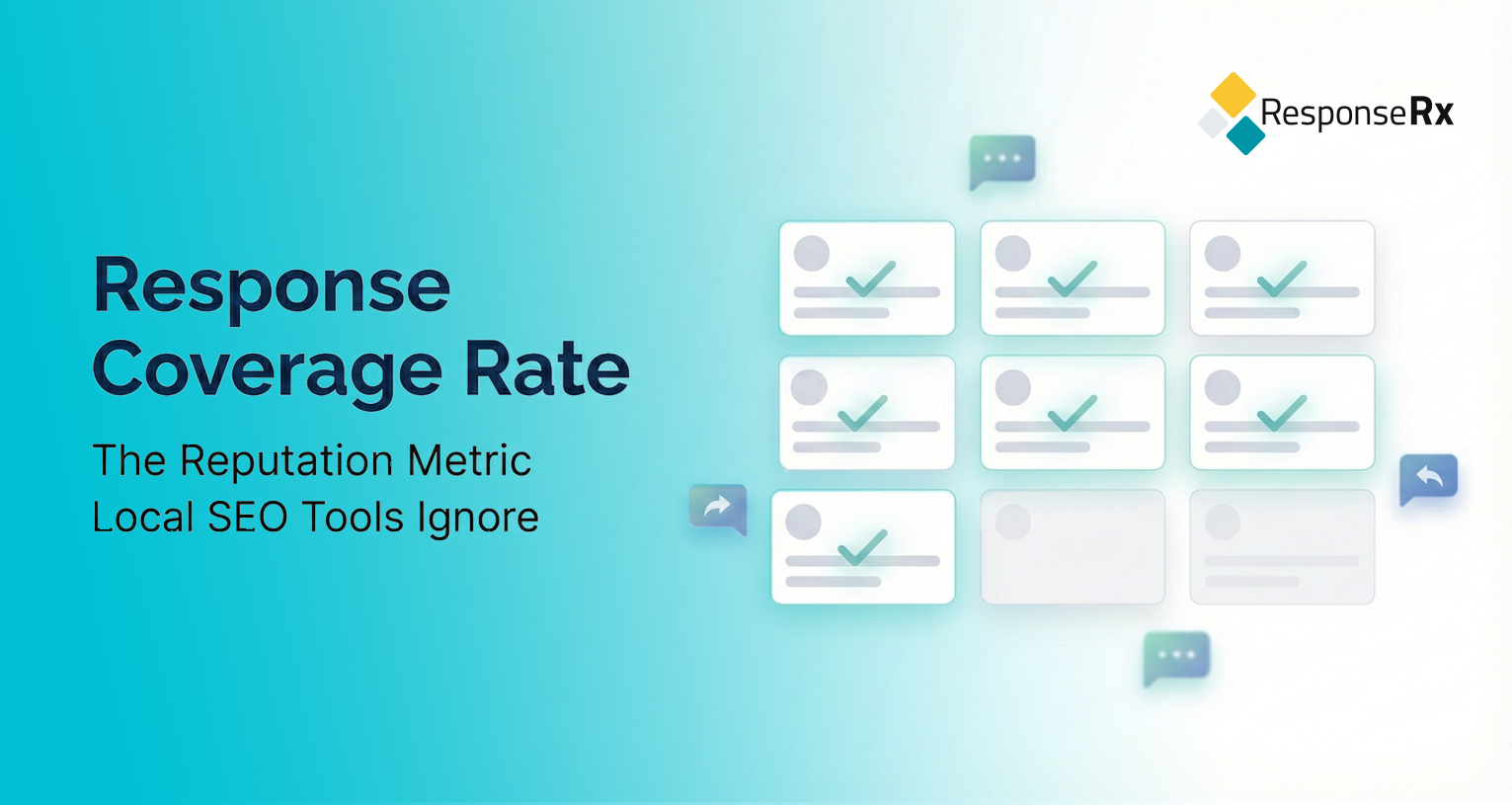
Response Coverage Rate is simple: the percentage of reviews that receive a public response.
It doesn’t measure how well the response is written or whether it’s positive or negative. It only measures whether the business shows up at all.
A business with a 4.8 rating and a 40% RCR sends a weaker trust signal than a business with a 4.6 rating and a 100% RCR — not because of sentiment, but because of completeness.
To prospective customers, selective responses feel evasive.
To algorithms, they look unstable.
Most practices don’t intend to ignore reviews. They respond selectively:
From the inside, this feels reasonable. From the outside, it creates a fragmented public record.
When someone scans reviews, unanswered entries raise subtle questions:
These questions aren’t always conscious — but they directly affect confidence.
Response Coverage Rate becomes more important as volume grows. At scale, there are only two visible states:
A complete operating record — or a fragmented one.
There is no middle ground once dozens (or hundreds) of reviews accumulate. High volume with low coverage doesn’t compound trust; it compounds uncertainty.
That’s why RCR is foundational inside the ResponseRx Reputation Signals Framework. You can’t build Trust Velocity on top of gaps.
If this idea is new, we explore the broader shift in how response behavior now shapes local visibility and trust in more detail here.
RCR is rarely tracked because it’s uncomfortable. It forces an honest question:
Are we actually present — or just occasionally reactive?
Most reputation tools emphasize star averages, review counts, and sentiment trends. Those are visibility metrics. RCR is a behavior metric, and behavior is harder to rationalize away.
For trust-heavy industries — especially healthcare — the target is straightforward:
100% response coverage.
Not because every response must be long or perfect, but because acknowledgment, consistency, and presence matter. Short, professional, compliant responses still count. Silence doesn’t.
Improving Response Coverage Rate rarely fails because of intent. It fails because of process.
Common breakdowns include reviews arriving across multiple platforms, unclear ownership, fear of saying the wrong thing publicly, and responses competing with patient-facing work.
The solution isn’t “try harder.” It’s to remove discretion from the system.
Practices that sustain high RCR tend to do three things consistently:
When response behavior is systematized, coverage stops being optional.
Review volume creates visibility. Response consistency converts visibility into trust.
If RCR is low:
RCR is the floor. Everything else sits on top of it.
If you’re not measuring Response Coverage Rate, you’re guessing about trust. In a world where patients — and increasingly AI systems — evaluate businesses based on visible patterns, guessing isn’t enough.
Reviews tell people what others experienced.
Responses show how you operate.
Coverage is what makes that story complete.
The strongest reputations aren’t built on perfect feedback — but on consistent presence when feedback appears.